
Trace Morgan County Former Owners
Finding who owned a Morgan County property takes patience. It is not a single search box. You start with the newest deed and work backward. Move through Morgan County property records one transfer at a time. The parcel number and legal description keep you anchored to the same land. Names and spellings drift over the decades, after all. A property search may begin online. Still, the clerk's deed books, microfilm, tax rolls, and archives carry the chain deeper than any website. Each source covers a different span of years. Check them in order to confirm every owner of record.
| Source | Years It Covers | Where Held | What It Shows |
|---|---|---|---|
| Current deed and index | Current web depth unverified | Morgan County Clerk | Grantor, grantee, deed type, date, and book/page |
| KDLA deed inventory | 1846-2015 | Clerk and Kentucky archives | Documented run of Morgan deed books |
| FamilySearch deed catalog | Deeds 1846-1901; indexes 1846-1970 | FamilySearch catalog | Fourteen microfilm reels and index routes |
| Tax assessment books | Listed runs from 1823-1892 | KDLA inventory | Annual ownership clues before and beside deeds |
Think of the table as a coverage map. It is not a guarantee that every volume survives. Recent former owners come from the clerk first. Then use the KDLA land-record inventory to spot an older series. Check the FamilySearch catalog for its microfilm. Tax books can support an early clue about prior owners. A tax listing still does not replace a deed.
Morgan County Deed Chain Timeline
Build the chain one transfer at a time. Record each link before you chase the next name. The blank dates below are deliberate working fields, because a model transfer would only blur the line between fact and method.
| Transfer Date | Grantor to Grantee | Deed Type | Book/Page |
|---|---|---|---|
| Newest recorded transfer | Prior owner to current grantee | Read instrument | Record exact reference |
| Earlier transfer | Earlier owner to prior owner | Read instrument | Record exact reference |
| Repeat to target era | Earlier grantor to grantee | Note unusual transfer | Keep volume and page |
Match the legal description at every row. A shared surname or a repeated first name is not enough. Neither is a later street address. One deed can cover several tracts, and a grantor may well have owned more than one Morgan County parcel.
Read Morgan County Deeds Backward
The newest deed names both sides of the transfer. The grantor conveyed the property; the grantee received it. That same grantor now becomes your next search subject, this time as a grantee in an older instrument. KDLA cautions that older indexes may be split into separate grantor and grantee volumes, alphabetized, and divided by book or document type. Work both sides independently. A single combined hit list may not be complete.
- Use the PVA owner and map ID to locate the newest purchase deed, with the present owner searched as grantee.
- Copy the grantor's name, deed type, recording date, source-of-title recital, and book/page exactly.
- Search that grantor as an earlier grantee. Check spelling variants, spouse names, trusts, estates, and legal entities.
- Compare legal descriptions and parcel clues, then repeat until the web search ends. Continue through the clerk, KDLA, or microfilm.
- Grantor and grantee
- The party conveying an interest and the party receiving it.
- Chain of title
- The ordered sequence of recorded transfers tied to the same land.
- Reverse index
- An index organized by grantor, used to find property a named party conveyed.
- Warranty and quitclaim
- A warranty deed carries title promises; a quitclaim conveys only the interest the grantor may have.
- Legal description
- The tract, lot, block, acreage, calls, and adjoining-land language that identifies land beyond its street address.
Morgan County Clerk Access Paths
The Morgan County Clerk site does not publish its search fields, image access, fees, or online cutoff. Confirm those details at the counter. Visit the clerk at 450 Prestonsburg Street in West Liberty or call 606-743-3949. Hours run Monday through Friday, 8 a.m. to 4 p.m. The office is also open Saturday, 8 a.m. to noon. The county-linked page remains the documented starting point for the recorded chain.
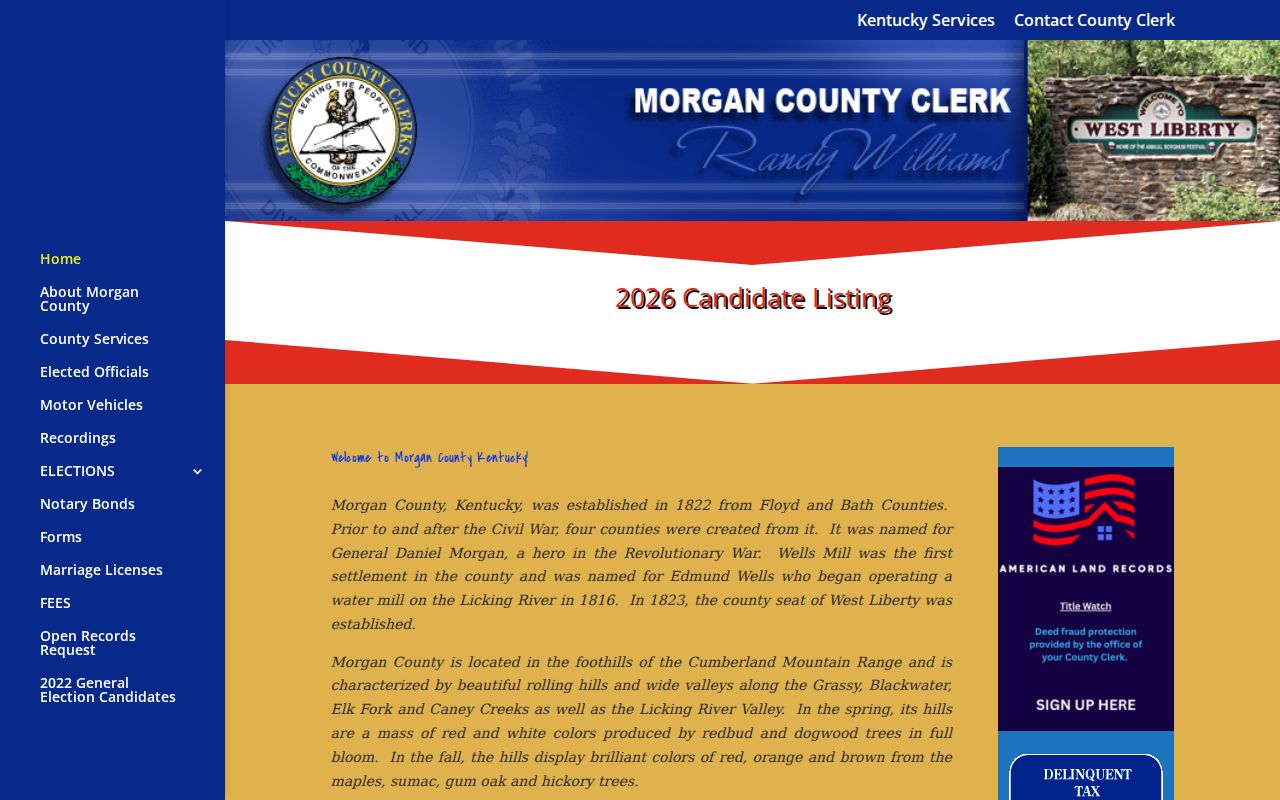
The clerk's official page establishes the web presence. Counter staff must confirm the indexed date range and how deep the historic images go. Ask whether the name indexes sit online, behind an account, or only at the counter. Ask whether older images appear on a courthouse terminal, and what an ordinary or certified copy costs. A narrow request should state the names. It should also state the date range, deed type, book and page, and any parcel clue. A non-exempt index or copy may be unavailable otherwise. A focused request under the Kentucky Open Records Act, KRS 61.870-61.884, is another channel. Note: The clerk's current web cutoff is not published, so no year should be inferred from the historical inventory.
Morgan County Microfilm Deed Route
FamilySearch catalogs Morgan County deeds from 1846 through 1901 and deed indexes from 1846 through 1970. They sit across fourteen microfilm reels. Getting in may depend on an account, an affiliate library, or FamilySearch Center rules. The catalog is only a finding aid. The volume and page must still be tied to the right land. Then check everything against the clerk-held record. KDLA also takes specific research requests by mail, phone, or internet, sometimes for a fee. Give staff the county, the series, and an approximate date. Add the parties and any book and page already found. The Morgan County Public Library and its genealogy club offer a local route. Their holdings include census, cemetery, family-history, and newspaper material. Those sources can bridge names. They cannot establish title.
Morgan County Heir Transfers
A tidy buyer-to-seller sequence can snap when land moves through an estate, a partition, a foreclosure, or a court-ordered sale. Expect search terms like executor, administrator, heir, commissioner, or sheriff. A probate file can identify the heirs and an order of sale, and the later fiduciary or commissioner deed puts the transfer back into the land chain. When a former owner died, treat the death date only as a clue for the Morgan Circuit Clerk probate search. A will, an inventory, or a court order can explain the path. Still, the recorded deed or judgment reference is what reconnects the event to the parcel. CourtNet is only a snapshot; the local clerk file is the official source.
Morgan County Courthouse Search Risks
Fire and storms shape what survives in Morgan County. KDLA records courthouse disasters in 1862 and 1925. Fiscal-court histories add an 1868 fire and the 2012 tornado. Each event forced replacement records, and no source lists every deed volume lost or rebuilt. A gap near one of these dates is a clue. It is not proof that a transfer vanished.
Ask the clerk or KDLA which index, deed book, or reconstructed series covers your year. Order books, tax assessments, and court files often hold cross-references that fill the hole. Morgan County formed in 1822 and later shed land to newer counties. An early tract may therefore sit in another county's deed records. Check Floyd, Bath, Rowan, Elliott, Menifee, Wolfe, Magoffin, or Johnson County instead.
Match Morgan County Land Clues
Kentucky law spells out one useful habit. Under KRS 382.110, every Morgan County deed must state its source of title. That recital usually names the earlier deed book and page. It is often the strongest link when you work a parcel chain backward. Map IDs here follow segmented strings like 089-00-00-017.00. The county publishes no digit-by-digit legend for them. Treat the string as a cross-reference only, never as a legal description.
Older rural deeds rarely lean on a street number. Instead they name a creek, ridge, branch, road, adjoining owner, or whole farm. Weigh acreage, calls, neighbors, lot and block, and the source-of-title language against each other. Where the deed and the map disagree on boundaries, a licensed surveyor settles it in the field. The public GIS cannot.
Morgan County Newspaper Bridges
Newspapers can bridge gaps that deed records leave open. The Morgan County Public Library has digitized Licking Valley Courier issues from 1911 through 1923. It keeps genealogy microfilm as well. An obituary can tie a person to an era and a place. A legal notice or sale advertisement works the same way. A farm name or road reference works the same way. That matters most when the modern street address simply did not exist yet.
Take any new clue back into the deeds, tax books, and plats. Remember what a newspaper actually shows. It reports events, not who held title. The same caution fits census and cemetery records. Use them to separate people and dates, then return to the recorded chain of ownership.
Morgan County Ownership Record Depth
Morgan County deed records run deep. The archival series begins in 1846 and continues through 2015. That span describes the deed inventory itself, not the clerk website's online coverage. FamilySearch's deed images stop earlier, and its indexes reach only to 1970. Tax assessment rolls begin even deeper, in 1823. That start predates the deed records by three years. When the deed path grows murky, turn to those rolls. They can suggest who was assessed for the land and when.
Chasing an owner before Morgan County existed takes one extra step. Place the tract where it sat at the time. Morgan was formed from Floyd and Bath counties. Its borders kept shifting as later counties formed. A complete property search can therefore cross county lines. The land itself never moved.
Coverage limit. The current online index cutoff is not verified. Use clerk counter access, deed books, microfilm, and archives for older owners.
Former owner lookups in Morgan County property records help with house histories, estate files, purchase diligence, and title work. A parcel number or deed records search can trace ownership back through decades of county transfers. Still, that chain of names is not a title opinion. Confirm anything material with the county custodian. A qualified title professional should review it too. Never use property records to track or harass a living person.