
Fields in Morgan Tax Records
Morgan County property tax records pull their fields from more than one custodian. The PVA values the parcel. The Morgan County Sheriff collects the current bill. Delinquent certificates and later tax-sale instruments can involve the county clerk, so noting the keeper beside each number keeps an assessed value from being mistaken for a balance due.
| Field | What It Shows | Where |
|---|---|---|
| Land and improvement values | Parts of the parcel assessment | Morgan PVA |
| Total assessed value | Fair-cash-value assessment basis | Morgan PVA |
| Exemption status | Relief applied to qualifying property | Morgan PVA |
| Current bill and payment | Amount billed, received, or due | Morgan County Sheriff |
| Delinquent entry | Owner, bill number, address, and map ID at publication | Public notice, sheriff, and clerk process |
An assessed value is not a sale promise. Kentucky requires real property to be assessed at fair cash value. The actual property tax depends on the assessment, exemptions, and levies. A recorded sale price is a separate fact.
January Sets Morgan Tax Assessments
The Morgan PVA real-property page explains that property is assessed each year at fair cash value. January 1 is the assessment date. The public roll is updated regularly. The PVA publishes no fixed refresh interval, and the PVA assessment explanation remains the official source for the annual fair-cash-value framework.

The PVA record supplies assessment context. Payment status still comes from the sheriff. A deed recorded later in the year can be newer than the name on the assessment record. Use the PVA card for the tax-roll view. Then compare the clerk's latest deed before treating the displayed owner as current. The PVA disclaimer also cautions that sale date, sale price, and property characteristics can be unverified.
Morgan Uses Three Value Methods
The Morgan PVA describes three ways to value property. Sales comparison looks at similar transfers and adjusts for the differences. Cost analysis estimates land plus replacement cost, less depreciation. Income analysis weighs what income-producing property can earn. The method can vary with the property. None turns a public assessment into a private appraisal for a particular sale.
The figures do not state what remains due on the property tax bill either. The cost approach separates land from improvements and depreciation. The income approach fits property whose rental stream supports a value estimate. Morgan County taxpayers should ask which data and method drove the parcel's figure, then compare the answer with the card's land and improvement components. A disagreement about physical facts may need correction first.
Trace a Morgan County Tax Bill
Morgan County publishes no live tax-bill lookup. Start with qPublic. Use it to identify the parcel and assessment, then treat the sheriff as the bill source, keeping the parcel ID and bill number with the request.
- Search the PVA by address, owner, or map/parcel ID and copy the matching assessment details.
- Contact the Morgan County Sheriff with the parcel ID and tax year to request current bill and payment status.
- Compare any exemption shown with the PVA's application record.
- If a delinquency appears, check the dated notice, then confirm payment, transfer, or sale status with the sheriff and clerk.
- Assessed value
- The PVA's value assigned under the assessment system.
- Levy
- A taxing body's rate used with the taxable assessment.
- Homestead exemption
- Assessment relief for qualifying property and applicants.
- Tax lien
- A legal claim tied to unpaid property tax.
The Morgan Sheriff Collects Tax
The Morgan County Sheriff serves as the property tax collection office. It sits at 450 Prestonsburg Street. The published phone is 606-743-3613. A 2025 notice directed payment there and listed weekday collection hours of 8 a.m. to 5 p.m., and the official sheriff page provides the tax-collection contact route.

The office route is clear. A live bill-search claim is not.
That 2025 notice said bills were mailed as white postcards. Payers were asked to write the bill number on a check and include the postcard. A mailed receipt required a self-addressed stamped envelope. Those details describe the 2025 cycle only. Confirm the current schedule and method before sending funds.
Note: The Morgan County sheriff remains the source for a current balance or receipt. No live tax account portal exists.
Morgan's Published Tax Calendar
The October 2, 2025 notice set a precise collection sequence. A 2 percent discount ran October 1 through November 1. Face value applied November 2 through December 31. A 5 percent penalty applied in January 2026. A 21 percent penalty then ran from February 1 through April 15, 2026.
Those dates are strong evidence of the local process. They are not the calendar forever. Each year requires its own sheriff notice. A sound tax record preserves the tax year, amount stage, and date checked.
Read Morgan Delinquency Records Carefully
The August 7, 2025 Morgan notice published 2024 delinquent real-property bills under KRS 424.130. Its table listed owner name, bill number, property address, and Map ID. Those fields make matching back to qPublic easy.
Publication is a dated event. It is not proof a bill is still unpaid. Payment, redemption, transfer, or a later sale can change the result. Confirm present status with the sheriff. Ask the clerk whether a delinquent certificate or later instrument was recorded. Never treat the listed owner as conclusive present title.
Morgan Tax Sale Date Unverified
The Kentucky Department of Revenue posted a tax-sale update dated March 28, 2025. Its Morgan County row listed no sale date. Registration rules, deposits, and redemption timing were absent too. Ask the sheriff and clerk for current terms. A delinquent list does not prove a sale occurred, and an announced sale does not prove title changed.
The completed trail takes more than the list. It may require the sale file, payment or redemption status, and a later deed. Foreclosure notices deserve the same caution. Late-2025 Morgan examples carried street addresses, map and parcel IDs, deed book and page citations, case numbers, and proposed sale terms. Each was a lead to the Circuit Clerk and the recorder, not proof of a final outcome.
A commissioner report, court order, later deed, or later assessment entry may show what happened next. Keep court foreclosure files and tax collection files separate.
Morgan Property Tax Exemptions
The Morgan PVA posts its exemption pages online. They cover homestead relief, disability relief, agricultural valuation, and organizational exemptions, each with different eligibility rules and required documents. The disability material calls for proof. Agricultural valuation sets a five-contiguous-acre threshold for horticultural land.
Apply through the PVA. Ask which tax year the relief affects, since an exemption reduces taxable value without changing broader assessment facts or the deed's owner of record. Keep approval or denial with that tax year.
Never infer eligibility from age, land use, or an owner name on the roll, because the PVA's program page and application process control. Agricultural use value is not unrestricted market value. When reviewing Morgan property tax records, label the gross assessment, the exempt amount, and the taxable result separately if the card supplies them. That clarity helps year-to-year comparisons.
Challenge a Morgan County Assessment
The Morgan PVA appeal page places the inspection period in May and requires a conference with the PVA before it closes. The statutory pattern follows May's first and third Mondays. Exact dates vary each year. The Morgan assessment appeal source displays the local conference-first process.
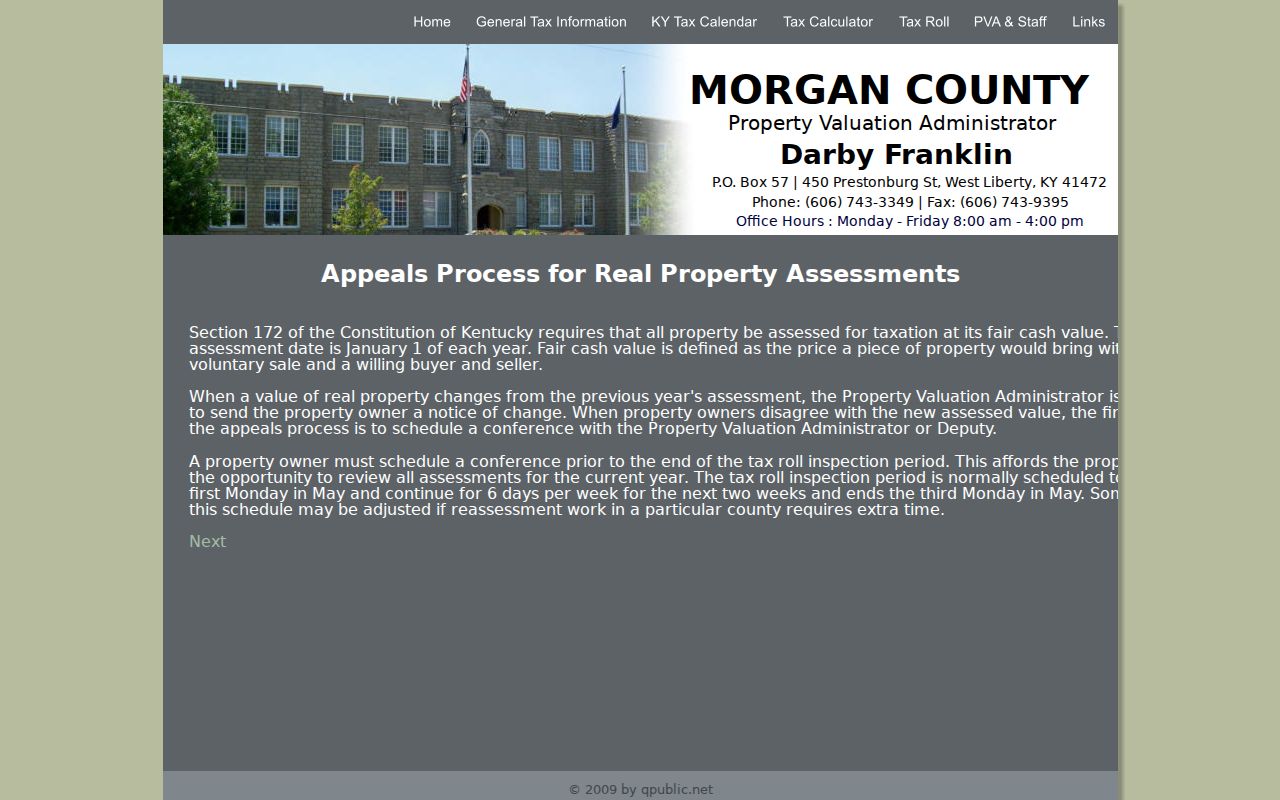
May dates change every year. Confirm them before planning any appeal. Review the property tax card early, and bring facts tied to the parcel, such as a corrected description, photos, condition evidence, comparable sales, or an appraisal. Ask the PVA about the next review step. An appeal contests the assessment itself, not the tax rate or deed terms.
Appeal window. A Morgan County owner must first confer with the PVA during the annual May inspection period. Verify the exact dates for the current year.
Request Missing Morgan Tax Records
Not every record lives online. The Morgan PVA answers assessment and exemption questions at 606-743-3349. The sheriff handles bill and payment questions. The clerk keeps recorded delinquent certificates. KDLA's Morgan inventory lists historic assessment books in runs reaching from 1823 through 1892.
A narrow request under the Kentucky Open Records Act, KRS 61.870 through 61.884, can seek a specific non-exempt record by parcel ID, year, and type. Ask about cost and format first. State guidance generally gives an agency five business days to respond, though exemptions and PVA tax confidentiality can limit release.
Old books answer a different question. They are not a current tax bill. The inventory lists Morgan assessment runs for 1823 through 1831, 1833, 1836 through 1838, 1840 through 1849, 1851 through 1862, 1865 through 1875, and 1879 through 1892. Gaps are part of the record. Search by the name and land clues used in that era, then connect the entry to a deed book, order book, or later parcel description. An old assessment entry is evidence of the tax roll for its year, not a present ownership certificate.